


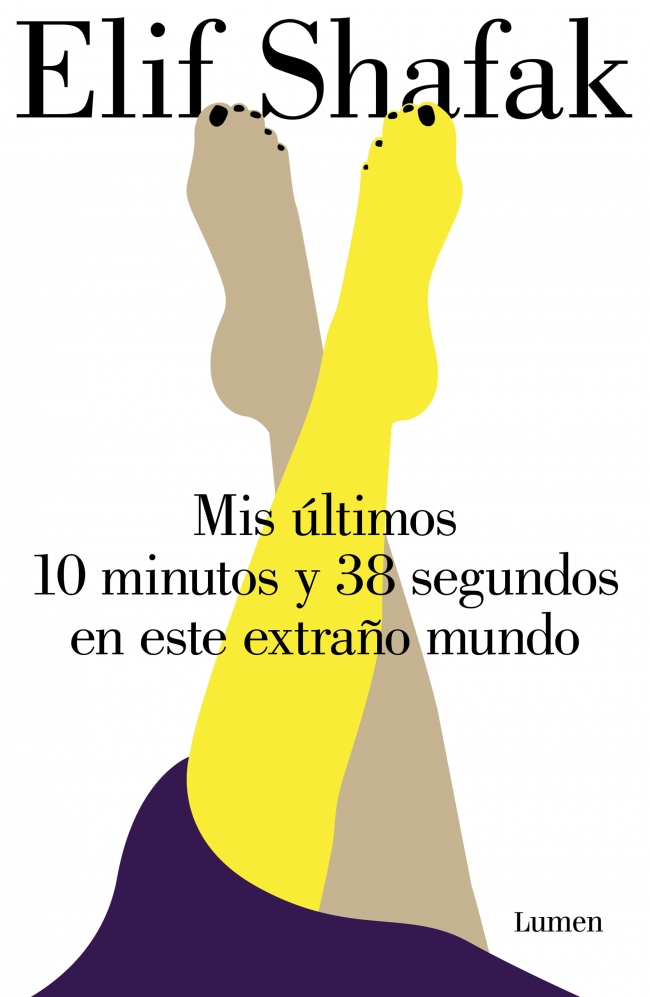
The latest novel by Turkish-born writer Elif Shafak, recently published by Lumen.
Technical specifications
My last 10 minutes and 38 seconds in this strange world
Elif Shafak
Trad. Antonia Martín
Lumen, 202 0
368 pages
The Cemetery of the Lonely in Kilyos, an hour's drive from the centre of Istanbul, is a place reserved almost exclusively for the damned. Its graves have no headstone, not even a name, and only a number to identify them. Undesirables, outcasts, misfits and, in recent years, a growing number of unidentified bodies - migrants drowned in the Aegean in their attempt to enter Europe - are taken in at this cemetery of the marginalised. It is in this cemetery that they bury the protagonist of My last 10 minutes and 38 seconds in this strange worldThe latest novel by the Turkish-born writer Elif Shafak (Strasbourg, France, 1971), a finalist for the 2019 Booker Prize, has just been published by Lumen. The Spanish translations of several of her works have been appearing in the same publishing house: The three passions (2016); The architect of the universe (2015); The fruit of honour (2012) y The Bastard of Istanbul (2009).
This is not the first novel that the essayist, columnist, teacher and women's rights activist has published in English, as this "traveller between cities, cultures and languages", as she defines herself, has alternated this language with Turkish in the 17 books she has published so far, 11 of which are novels. Elif Shafak, who took her mother's name as the surname of her literary alias, has been accumulating awards since she received the Rumi Prize in 1998 for her first novel, Pinhan (The Hidden), awarded for the best mystical work in Turkey, where she has managed to become the most widely read author, while at the same time facing problems with the courts for dealing with the Armenian genocide in The Bastard of IstanbulThe case was eventually dismissed. Distinguished with the Order of Arts and Letters of the French Republic, shortlisted for the Orange Prize and finalist last year for the Booker Prize, among other awards, Shafak has become an acclaimed voice on the international literary scene, but also a respected figure as a defender of freedom of expression and a champion of minorities, immigrants, the marginalised, diversity and inclusion, as present in her written corpus as in her public interventions.
In the genesis of My last 10 minutes and 38 seconds in this strange world two subjects converge, both of which intrigued and fascinated the author, as she explains in the promotional video published by Penguin Books UK. On the one hand, a scientific study showing that, after death, when the heart stops beating, the human brain continues to function for a few minutes, which made her wonder what would happen during that time, what we would remember if we were able to remember... On the other hand, the anonymity of the Cemetery of the Lonely, who were the people buried there, what story is hidden behind the number of each grave? Shafak evokes an event he read about in a newspaper in Istanbul a few years ago. A sex worker was found in a rubbish bin, having been brutally murdered and dumped there. And he decides to make her the protagonist of his novel, one of those outcasts, repudiated by their family, their village or society in general, who end up buried in the Cemetery of the Lonely, and to whom he will give a name, an individuality and a story. The novel narrates the life of Tequila Leila, prostitute and inhabitant number 7053 of the eerie cemetery.
The work is divided into two main parts, "The Mind" and "The Body", and a very brief third part that serves as an epilogue. Although intimately connected in terms of subject matter - the second part relates the reaction of the protagonist's friends on learning of her death - the first could function perfectly well as a novel in its own right and, in fact, it is therein that its strength and originality lie. The figure of the prostitute as the main character in a story has appeared before in Middle Eastern literature, with one of the pioneers in placing them at the centre of her novels being the Egyptian writer Nawal El Saadawi in her Woman at zero pointwhich appeared in the Arab world in the 1970s, although it was not published in Spanish until 2007, thanks to the publishing house Capitán Swing.
In "The Mind", focus and structure come together to give this first part an appealing singularity. Tequila Leila is already dead, at least her heart has stopped beating, but her mind continues to function. She finds herself, her body, thrown into a metal container on the outskirts of Istanbul. The 10 minutes and 38 seconds that her brain will remain active will serve to recall the most important moments of her life, every minute, a memory, but also an aroma or a taste. Like the salty taste on her tongue when, at birth, she was placed in a basin full of salt flakes to make her cry, a custom practised in her village when babies remained mute after birth, in the belief that this would stop them smelling like angels and allow them to join the earthly world. Her birth took place in 1947 and in the following episodes the protagonist will tell us the details of her life, peppered with references to historical moments in her native Turkey and elsewhere in the world, such as the invasion of Iraq in 1990, which coincides with the moment of her death...
This first part also serves to introduce his group of friends, the inseparable "five" who will give meaning to his life. They represent the cultural, ethnic, linguistic and social diversity that characterises contemporary Turkey, but, above all, they personify those who live on the margins of society, disowned, reviled, misunderstood and despised, and who find in their small group the solidarity and understanding that society denies them. As Elif Shafak explains, "in countries where there is a decline in democracy or where the public space is intolerant of difference or diversity, friendship has a very important place".
It is these five who star in the second part of the play, where we get to know them better, to understand the nature and depth of the friendship that unites them. Together they decide to rescue Leila's body from oblivion, removing it from the Cemetery of the Lonely to take it to a place more worthy of their friend, with scenes reminiscent of the most desperate and absurd moments of The death of a bureaucrat (1968), the famous film by Cuban director Tomás Gutiérrez Alea.
Despite the harshness of the stories of the characters in Shafak's latest work, there is much in it that is life-affirming, as described by the author herself, for whom the novel should serve as "a democratic space to represent diversity". It is thus a story of friendship, but also a defence of diversity and inclusion. A call to rescue the marginalised from the margins of society, if only so that those who have lived as cursed do not perish as icy numbers.
By Natalia Arce
The publisher makes an excerpt of this work available to the readers. via the following link:
The novel is also available in audio format narrated by Elsa Veiga (duration 11 hours and 13 minutes) and it is possible to listen to an excerpt of this audio by clicking here.
 Portuguese